Characteristics Of Non Programmed Decisions: A Comprehensive Guide
Characteristics Of Non Programmed Decisions encompass decisions made in unstructured situations that defy routine solutions. Imagine a CEO facing a sudden economic crisis, where traditional strategies may not suffice.
Understanding these decisions is crucial for navigating unpredictable scenarios, unlocking innovation, and adapting to changing environments. The concept traces its roots back to Herbert Simon's seminal work on bounded rationality, recognizing the limitations of human decision-making in complex situations.
This article delves into the key Characteristics Of Non Programmed Decisions, examining their unique features, types, and implications for decision-making in the face of uncertainty.
Characteristics Of Non Programmed Decisions
Characteristics Of Non Programmed Decisions are crucial for understanding decision-making in uncertain and complex situations. These decisions, often made by top-level management, require unique approaches and considerations.
- Unstructured
- Novel
- Significant
- Strategic
- Time-constrained
- High-risk
- Involve multiple stakeholders
- Require creativity and innovation
These characteristics highlight the complexity and importance of Characteristics Of Non Programmed Decisions. They often involve long-term consequences, require a comprehensive understanding of the organization and its environment, and demand creative and innovative thinking. By understanding these characteristics, decision-makers can better navigate the challenges and opportunities presented by non-programmed decisions.
Unstructured
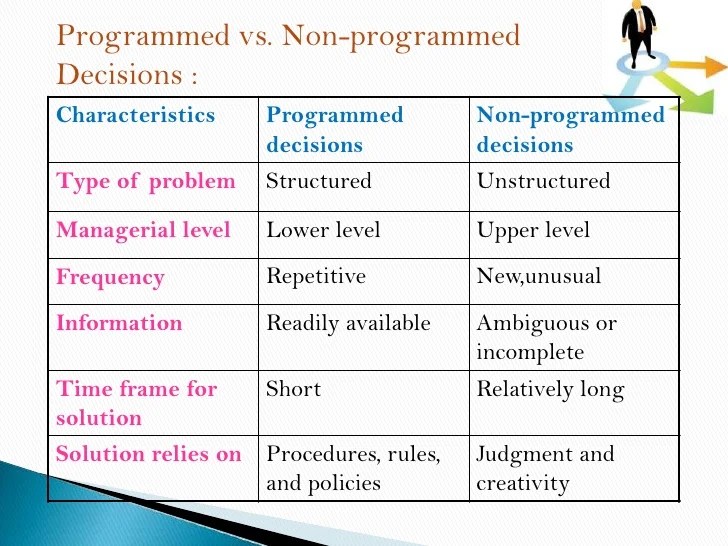
Unstructured is a critical component of Characteristics Of Non Programmed Decisions. It refers to the lack of well-defined procedures or routines for addressing a particular decision. This absence of structure creates challenges and opportunities for decision-makers, as they must rely on creativity, experience, and judgment to find solutions.
The unstructured nature of non-programmed decisions often stems from the complexity and uniqueness of the situation. For instance, a company facing a major crisis or a rapidly changing market environment may encounter problems that cannot be solved using existing procedures. In such cases, decision-makers must draw upon their knowledge and expertise to develop innovative solutions.
Understanding the unstructured nature of non-programmed decisions is crucial for effective decision-making. It allows managers to recognize the limitations of traditional approaches and to adopt more flexible and creative methods. By embracing the unstructured nature of these decisions, organizations can foster innovation, adapt to change, and gain a competitive advantage.
Novel
Within the realm of Characteristics Of Non Programmed Decisions, Novel captures the unique and unprecedented nature of these decisions. Unlike programmed decisions that rely on existing routines, non-programmed decisions often involve situations that are new, unfamiliar, or complex. This Novel aspect presents both challenges and opportunities for decision-makers, requiring creativity, innovation, and a willingness to venture beyond established boundaries.
- Unprecedented Challenges
Non-programmed decisions often arise from unforeseen circumstances or rapidly changing environments. These challenges lack clear solutions, forcing decision-makers to navigate uncharted territory. - Innovative Solutions
The Novel nature of non-programmed decisions demands innovative approaches. Decision-makers must think outside the box, explore new possibilities, and embrace creativity to find effective solutions. - Learning and Adaptation
Non-programmed decisions offer opportunities for learning and adaptation. By grappling with novel situations, organizations can enhance their knowledge, identify new patterns, and improve their decision-making capabilities. - Competitive Advantage
Organizations that excel at making non-programmed decisions gain a competitive advantage. They can respond swiftly to market disruptions, seize new opportunities, and differentiate themselves from competitors.
In essence, the Novel aspect of Characteristics Of Non Programmed Decisions highlights the importance of embracing uncertainty, fostering creativity, and seeking innovative solutions. By understanding and leveraging this Novel component, decision-makers can effectively navigate complex and rapidly evolving business landscapes.
Significant
Within the spectrum of Characteristics Of Non Programmed Decisions, Significant holds a critical position. These decisions are weighty, bearing substantial consequences that can profoundly impact an organization's trajectory. Their significance stems from various facets, each contributing to their complexity and importance.
- Long-Term Impact
Non-programmed decisions often have lasting effects, shaping an organization's future direction and performance. They involve strategic choices that determine the allocation of resources, the pursuit of new opportunities, and the overall positioning of the organization.
- High Stakes
These decisions carry considerable risk and uncertainty. They involve substantial investments, potential reputational damage, and the well-being of stakeholders. The stakes are high, making it imperative for decision-makers to carefully weigh the potential outcomes.
- Organizational Alignment
Non-programmed decisions require alignment across the organization. They necessitate buy-in from various departments and stakeholders, ensuring that the chosen path is supported and implemented effectively.
- Resource Allocation
These decisions significantly impact resource allocation. They determine how an organization's limited resources are invested, whether in new ventures, technological upgrades, or talent acquisition.
In summary, the Significant nature of Characteristics Of Non Programmed Decisions underscores their weighty implications and far-reaching consequences. Understanding and effectively addressing these decisions is crucial for organizations seeking to navigate complex and uncertain environments, make strategic choices, and achieve long-term success.
Strategic
Within the spectrum of Characteristics Of Non Programmed Decisions, Strategic holds a pivotal position. These decisions are characterized by their long-term impact and their alignment with an organization's overall goals and objectives. The Strategic nature of non-programmed decisions stems from their profound influence on an organization's future direction and performance.
Non-programmed decisions are often triggered by major changes in the external environment, such as technological advancements, shifts in market demand, or the emergence of new competitors. These decisions require a comprehensive understanding of the organization's strengths, weaknesses, and competitive landscape. Decision-makers must carefully consider the potential consequences of their choices and align them with the organization's long-term vision and mission.
Real-life examples of Strategic non-programmed decisions include major investments in new product development, acquisitions or mergers, and the adoption of new technologies. These decisions involve significant risk and uncertainty, but they also have the potential to transform an organization's trajectory.
Understanding the relationship between Strategic and Characteristics Of Non Programmed Decisions is crucial for organizations seeking to navigate complex and uncertain environments. By making well-informed and Strategic non-programmed decisions, organizations can position themselves for long-term success and gain a competitive advantage.
Time-constrained
Within the realm of Characteristics Of Non Programmed Decisions,Time-constrained emerges as a critical component. These decisions are often made under significant time pressure, where the need for a timely response outweighs the luxury of an extended decision-making process. The Time-constrained nature of non-programmed decisions stems from the dynamic and unpredictable nature of the situations they address.
The relationship between Time-constrained and Characteristics Of Non Programmed Decisions is a two-way street. On the one hand, time constraints can significantly impact the decision-making process, often forcing decision-makers to rely on intuition and experience rather than extensive analysis. On the other hand, the very nature of non-programmed decisions - their uniqueness, complexity, and strategic importance - often demands timely responses, making time constraints an inherent characteristic of these decisions.
Real-life examples of Time-constrained non-programmed decisions abound in the business world. A company facing a sudden market disruption may need to make quick decisions regarding product adjustments or marketing strategies. Similarly, an organization responding to a natural disaster or a public relations crisis must act swiftly to minimize negative consequences.
Understanding the connection between Time-constrained and Characteristics Of Non Programmed Decisions is crucial for effective decision-making in fast-paced and uncertain environments. By recognizing the time constraints inherent in these decisions, organizations can develop processes and strategies to facilitate timely and well-informed decision-making. This understanding can lead to improved crisis management, enhanced adaptability to changing market conditions, and a competitive advantage in dynamic industries.
High-risk
Within the intricate tapestry of Characteristics Of Non Programmed Decisions, High-risk stands as a defining thread, weaving a complex relationship that shapes decision-making in uncertain and dynamic environments. The High-risk nature of these decisions arises from their inherent uncertainty, far-reaching consequences, and potential for significant losses.
The cause-and-effect relationship between High-risk and Characteristics Of Non Programmed Decisions is reciprocal. On the one hand, the uniqueness and complexity of non-programmed decisions often lead to uncertain outcomes, escalating the level of risk associated with them. On the other hand, the high stakes involved in these decisions amplify the potential consequences of failure, further elevating their risk profile.
Real-life examples of High-risk non-programmed decisions abound in the business world. A company venturing into a new market with an untested product faces substantial risk. Similarly, an organization contemplating a major acquisition or merger grapples with the potential for financial and operational setbacks. These decisions require careful evaluation and risk mitigation strategies to navigate the challenges and maximize the chances of success.
Understanding the connection between High-risk and Characteristics Of Non Programmed Decisions has practical applications in various domains. It enables organizations to develop robust risk management frameworks, allocate resources prudently, and make informed decisions even in the face of uncertainty. By acknowledging and addressing the risks associated with non-programmed decisions, organizations can enhance their resilience, safeguard their interests, and position themselves for long-term success.
In conclusion, the High-risk nature of Characteristics Of Non Programmed Decisions underscores the importance of careful analysis, prudent decision-making, and effective risk management. By recognizing the inherent risks and adopting appropriate strategies, organizations can navigate the complexities of non-programmed decisions and harness their potential for innovation, growth, and competitive advantage.
Involve multiple stakeholders
Within the realm of Characteristics Of Non Programmed Decisions, the involvement of multiple stakeholders stands as a significant aspect, shaping the dynamics and outcomes of decision-making processes. This involvement introduces a complex interplay of perspectives, interests, and objectives, necessitating careful consideration and stakeholder management.
- Diverse Perspectives
Non-programmed decisions often impact a wide range of stakeholders, each with their own unique viewpoint and priorities. These perspectives enrich the decision-making process, fostering a more comprehensive understanding of the situation and potential consequences.
- Conflicting Interests
The involvement of multiple stakeholders can surface conflicting interests and objectives. Balancing these interests requires skillful negotiation, compromise, and a commitment to finding mutually acceptable solutions.
- Resource Allocation
Non-programmed decisions often involve the allocation of scarce resources. The involvement of stakeholders ensures that resource allocation aligns with their priorities and values, enhancing the legitimacy and acceptance of the decision.
- Accountability and Transparency
When multiple stakeholders are involved, decision-makers are held accountable for their choices. This accountability promotes transparency and encourages ethical decision-making.
Understanding the implications of involving multiple stakeholders in Characteristics Of Non Programmed Decisions enables organizations to navigate the complexities of these decisions effectively. By fostering inclusive stakeholder engagement, considering diverse perspectives, and managing conflicting interests, organizations can harness the collective wisdom and support necessary for successful decision-making in dynamic and uncertain environments.
Require creativity and innovation
Within the realm of Characteristics Of Non Programmed Decisions, the requirement for creativity and innovation stands as a defining feature. This connection stems from the inherent nature of non-programmed decisions as unique, complex, and often lacking clear-cut solutions.
Non-programmed decisions demand a departure from conventional approaches, calling for fresh perspectives and innovative thinking. Creativity allows decision-makers to generate novel ideas and explore unconventional solutions, while innovation enables them to translate these ideas into practical and effective actions.
Real-life examples abound in the business world. The development of groundbreaking products, the implementation of disruptive strategies, and the successful navigation of unforeseen challenges all exemplify the critical role of creativity and innovation in non-programmed decision-making.
Understanding the connection between Require creativity and innovation and Characteristics Of Non Programmed Decisions has practical applications in various domains. It underscores the importance of fostering a culture of innovation within organizations, empowering decision-makers to embrace creativity, and investing in activities that stimulate new ideas and approaches. By harnessing the power of creativity and innovation, organizations can unlock their potential for growth, adaptation, and competitive advantage in an ever-changing business landscape.
In delving into the Characteristics Of Non Programmed Decisions, this article has illuminated the unique challenges and opportunities inherent in these decisions. Key insights include the significance of embracing creativity and innovation, the importance of considering diverse stakeholder perspectives, and the need for organizations to foster a culture of adaptability and learning.
Understanding these characteristics enables organizations to navigate complex and uncertain environments, make well-informed choices, and gain a competitive advantage. By investing in creativity, innovation, and stakeholder engagement, organizations can unlock their potential for growth and success in the rapidly evolving business landscape.
Who Is Guanyu Zhou, The Rising Star In Formula One?
Unveiling The Truth: Brandi Rhodes' Remarkable Journey
How To Encourage Imaginative Play With "Mickey Does Mickey"

ncG1vNJzZmidnZ7BunrApqpsZpSetKrAwKWmnJ2Ro8CxrcKeqmebn6J8pLTAq5icrJWntrTAyJyqZqeWYruwuoypqaifopa6rrHDZpuem5motrC60mefraWc